
Vi har lige fået publiceret artikel om forskningsprotokol til projektet “Future Patient-telerehabilitering af hjertesvigtpatienter” i Journal of Medical Internet Research (JMIR) – se link:
www.researchprotocols.org/2019/9/e14517/
Artikel
New publication: Developing a telerehabilitation programme for postoperative recovery from knee surgery
Developing a telerehabilitation programme for postoperative recovery from knee surgery:
Specifications and requirements
The development of the sensor-based telerehabilitation programme was carried out based on user needs. The programme includes a portable platform for the patient as well as a web-based platform for the healthcare professional, thus allowing for an individualised rehabilitation programme. Communication, training, reporting, and information services were provided for the patients. Moreover, the portability and usability of the programme were enhanced by utilising the system in offline mode as well. Application The programme is currently being tested in the North Denmark Region to assess the feasibility and acceptance of a telerehabilitation programme as an alternative solution to the self-training programme for patients who have been discharged from knee surgery. The preliminary results of our assessment showed a high level of acceptance among the users. Discussion In this study, a semi-online
Ny artikel med resultater fra forskningsprojektet Teledialog
Ny artikel med resultater fra forskningsprojektet Teledialog er netop publiseret – se her.
Integration of Rehabilitation Activities Into Everyday Life Through Telerehabilitation: Qualitative Study of Cardiac Patients and Their Partners
By Dinesen et. al.
Abstract
Background: Implementation of cardiac rehabilitation has not been optimal, with patient participation rates below 50%. Factors that contribute to cardiac patients’ lack of participation in rehabilitation programs are patient motivation, logistical difficulties in getting to the rehabilitation facilities, lack of psychosocial elements, and individualization of activities in the rehabilitation programs. Telerehabilitation has been proposed as a new way to address the challenge of engaging and motivating cardiac patients and their partners to participate in rehabilitation.
Objective: The aim of this study was to explore the experiences of cardiac patients and their partners of participating in the Teledialog Telerehabilitation Program (TTP). The Teledialog program consisted of a digital rehabilitation plan, transmission of health data from patient’s home to hospital and health care center, and an interactive Web portal with information and training videos.
Methods: This case study used a theoretical approach combining the “community of practice” approach and self-determination theory. A triangulation of data collection techniques was used, including documents, participant observation (72 hours), and qualitative interviews with cardiac patients and their partners enrolled in the telerehabilitation group. A total of 14 cardiac patients, 12 patient spouses/partners, and 1 son participated in the study. The participants were interviewed at enrollment in the telerehabilitation program and after 12 weeks of participation in the program. Interview data were analyzed using NVivo 11.0.
Results: Patients and their partners found the Web portal ActiveHeart.dk and the electronic rehabilitation (e-rehabilitation) plan to be helpful tools for health education, coordinating rehabilitation goals, creating an overview of the data, and ensuring continuity in the rehabilitation process. The patients felt that the TTP treated them as individuals, gave them a sense of autonomy, and provided enhanced relatedness to health care professionals and partners and a sense of competence as active participants in their own rehabilitation process. Some patients missed being part of a community of practice with other cardiac patients and did not use the Web forum. Patients’ partners found that the telerehabilitation program gave them a sense of security and helped them balance their involvement as a partner to the patient and not push the patient too hard.
Conclusions: Cardiac patients and their partners found telerehabilitation technologies a useful digital toolbox in the rehabilitation process. Telerehabilitation motivated the patients to integrate rehabilitation activities into their work schedule and everyday life and made them feel like unique individuals. Participating in the Teledialog Telerehabilitation Program might not be a suitable strategy for all cardiac patients. Being a patient’s partner in the telerehabilitation program was associated with a heightened sense of security, navigation between active involvement in the rehabilitation process, being an equal partner, and not pushing the patient too hard.
Artikel: Conventional Rehabilitation Therapy Versus Telerehabilitation in Cardiac Patients
A Comparison of Motivation, Psychological Distress, and Quality of Life
Af Helle Spindler, Kasper Leerskov, Katrine Joensson, Gitte Nielsen, Jan Jesper Andreasen og Birthe Dinesen
The Use of Telerehabilitation Technologies for Cardiac Patients to Improve Rehabilitation Activities and Unify Organizations
Qualitative study by Dinesen & Spindler.
Results
The case study of cooperation in an interorganizational context of cardiac telerehabilitation program is characterized by the following key themes and patterns: (1) integrated workflows via a shared digital rehabilitation plan that help integrate workflow between health care professions and organizations, (2) joint clinical practice showed as a community of practice in telerehabilitation developed across professions and organizations, and (3) unifying the organizations as cooperation has advanced via a joint telerehabilitation program across municipalities and hospitals.
Conclusions
The Teledialog Telerehabilitation Program was a new innovative cardiac program tested on a large scale across hospitals, health care centers, and municipalities. Assessments showed that the Teledialog program and its associated technologies helped improve interorganizational cooperation and reduce fragmentation. The program helped integrate the organizations and led to the creation of a community of practice. Further research is needed to explore long-term effects of implementation of telerehabilitation technologies and programs.
See paper at rehab.jmir.org/2018/2/e10758.
Hjertepatienters erfaringer med en telerehabiliterings web-portal
Er du interesseret i at vide hvordan brugen af en online portal, der er udviklet som et værktøj til telerehabilitering af patienter med hjertelidelser, kan bruges til både patientuddannelse og forbedring af patienternes sundhedskompetencer?
Laboratoriet for Velfærdsteknologi har netop fået udgivet en artikel i journalen Patient Education and Counseling:
Cardiac patients’ experiences with a telerehabilitation web portal: Implications for eHealth literacy.
White Paper om Telehealth Innovation
Transatlantic Telehealth Research Network (TTRN) har netop publiceret et White Paper om “Telehealth Innovation: Current Directions and Future Opportunities” for samarbejde mellem forskere, sundhedsprofessionelle og industrien. Forskere ved Laboratoriet for Velfærdsteknologi ved AAU har haft en væsentlig rolle ved udarbejdelse af dokumentet.
Ny bog om telerehabilitering
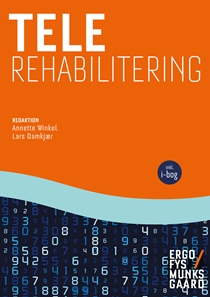 Forskergruppen ved Laboratoriet for Velfærdsteknologi medviker i ny bog om Telerehabilitering.
Evaluation of Commercial Self-Monitoring Devices for Clinical Purposes
Artiklen “Evaluation of Commercial Self-Monitoring Devices for Clinical Purposes: Results from the Future Patient Trial, Phase I” af Søren Leth, John Hansen, Olav W. Nielsen og Birthe Dinesen er udgivet i Sensors og tilgængelig online.
“The Heart Game”: Using Gamification as Part of a Telerehabilitation Program for Heart Patients
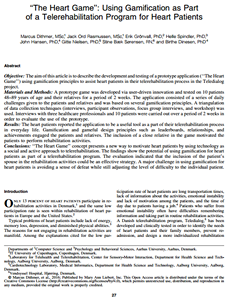 Artikel i Games for Health Journal
Volume 5, Number 1, 2016
Mary Ann Liebert, Inc.
DOI: 10.1089/g4h.2015.0001